
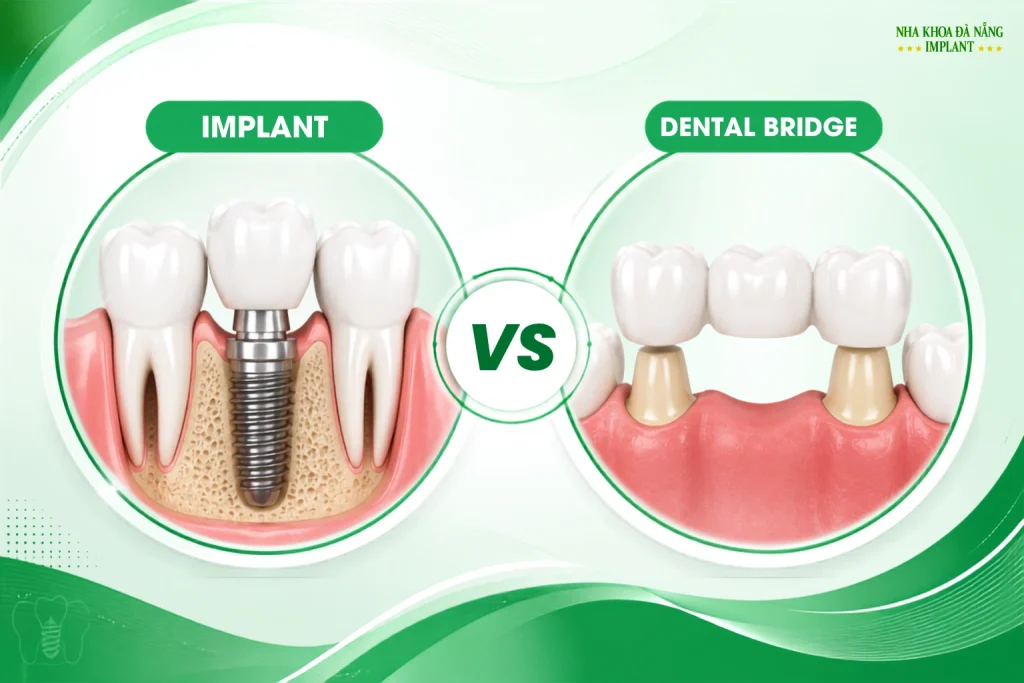
When one tooth is missing, many people often wonder between two common options: a dental implant or a dental bridge. Dental implants have the advantage of not requiring the adjacent teeth to be reduced, help maintain jawbone, and function similarly to natural teeth. Meanwhile, dental bridges usually require less treatment time and have a lower initial cost.
Implant or Dental Bridge
So, which is better for replacing a single missing tooth: a dental implant or a dental bridge? The answer depends on the condition of the jawbone, the health of the adjacent teeth, treatment suitability, and each patient’s individual needs. Let Da Nang Implant Dental Clinic take a closer look at these two options in the article below.
Losing a tooth, especially a molar, may not cause obvious problems immediately. However, leaving the space untreated for a long time may lead to several changes in the mouth, including:
According to the American Dental Association, a gap caused by a missing tooth may affect chewing, cause the remaining teeth to shift, and in some cases lead to bone loss in the area. Therefore, patients should have an early dental examination to determine the most suitable restoration option.
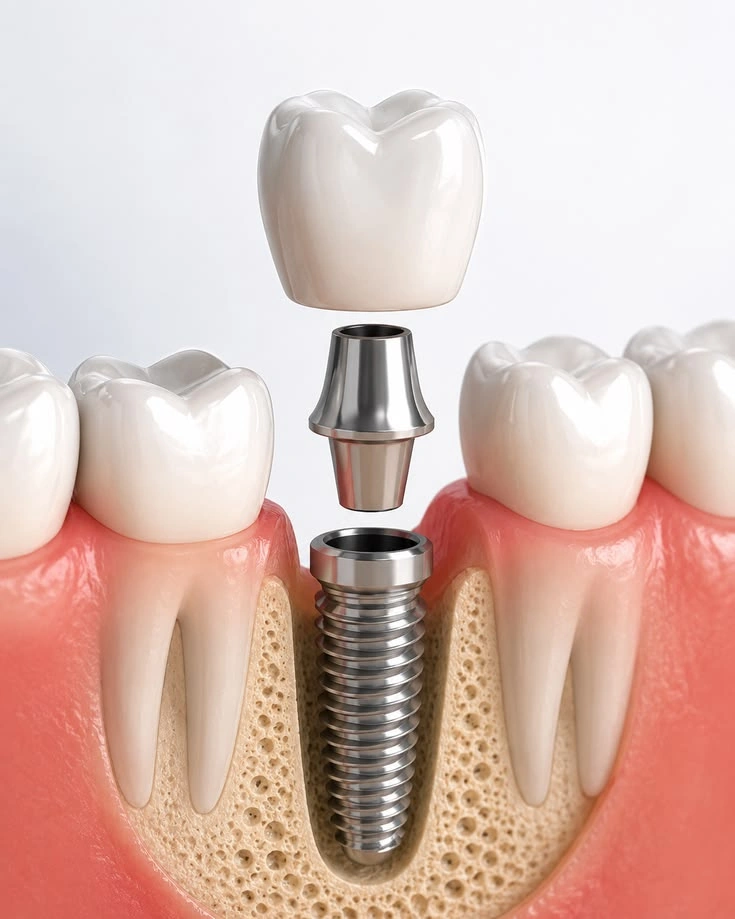
Dental implant treatment involves placing an implant made of biocompatible material into the jawbone to replace the missing tooth root. Once the implant becomes stable in the bone, the dentist attaches an abutment and a dental crown on top.
What Is a Dental Implant
A single dental implant usually consists of three parts:
Dental implants are considered one of the restoration options that most closely resemble the structure of a natural tooth because they replace both the root and the visible crown. However, implant treatment involves surgery and requires time for the implant to integrate with the jawbone.
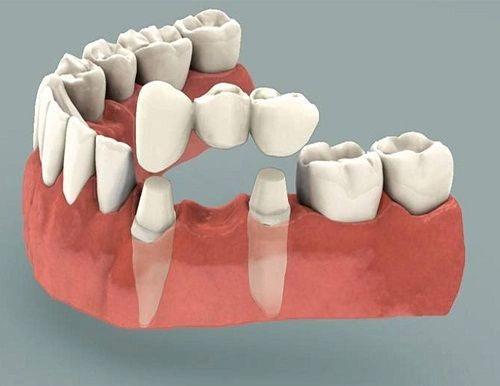
A dental bridge uses the two teeth next to the missing-tooth space as supporting teeth for an artificial tooth in the middle. To replace one missing tooth with a traditional bridge, the dentist usually needs to reduce the two adjacent teeth and place a restoration consisting of at least three connected dental crowns.
What Is a Dental Bridge?
A dental bridge consists of:
A dental bridge is fixed in place and can only be removed by a dentist. Its long-term success depends largely on the health of the supporting teeth and the ability to keep the area underneath the bridge clean.
| Criteria | Dental Implant | Dental Bridge |
|---|---|---|
| Restoration structure | Replaces both the tooth root and crown | Replaces only the visible tooth above the gum |
| Effect on adjacent teeth | Usually does not require reducing adjacent teeth | Usually requires reducing two teeth for support |
| Bone in the missing-tooth area | Helps maintain bone around the implant | No tooth root is present in the missing-tooth area |
| Chewing ability | Stable and functions independently | Depends on the health of the supporting teeth |
| Treatment time | Usually longer because osseointegration is required | Usually completed more quickly |
| Surgery | Required | Usually not required |
| Initial cost | Usually higher | Usually lower |
| Oral hygiene | Cleaned around the individual implant crown | Additional tools are needed to clean under the bridge |
| Treatment conditions | Depends on general health, jawbone, and gum tissue | Depends on the quality of the supporting teeth |
This is one of the most important differences when considering a dental implant or a dental bridge.
With an implant, the missing tooth is restored independently, so the two adjacent teeth usually do not need to be reduced. This helps preserve as much natural tooth structure as possible.
In contrast, a traditional dental bridge uses the adjacent teeth as supporting teeth. The dentist must remove some tooth structure to create enough space for the crowns. Once tooth structure has been reduced, it cannot naturally return to its original condition, and the supporting teeth must share the chewing forces of the bridge.
If both adjacent teeth are completely healthy, an implant generally offers a clear advantage in preserving natural tooth structure. However, if these teeth have large cavities, significant damage, or existing crowns and already require restoration, a dental bridge may be a reasonable option.
After tooth loss, the bone around the former tooth root gradually changes because it no longer receives functional stimulation in the same way.
An implant is placed directly into the jawbone and receives chewing forces, so it may help maintain the bone around the restored area better than a traditional bridge. However, an implant cannot completely prevent all changes in bone and gum tissue.
A dental bridge only fills the space above the gum and does not have a root inside the bone. Therefore, the bone underneath the bridge may continue to change over time.
A dental implant functions independently and does not transfer all chewing forces to the adjacent teeth. When properly planned and successfully integrated with the bone, an implant can provide good stability and chewing function similar to that of a natural tooth.
A dental bridge can also restore chewing function effectively. However, its stability depends directly on the condition of the supporting teeth. If one supporting tooth develops decay, pulp inflammation, a crack, or periodontal disease, the entire bridge may be affected.
Both dental implants and dental bridges can provide excellent aesthetic results when properly designed and performed.
For an implant in the front-tooth area, the dentist must carefully assess implant position, bone thickness, gum contour, and crown shape. A well-planned implant restoration can create a tooth that blends naturally with the surrounding teeth.
Dental bridges can also provide good color and shape. However, when the bone and gums in the missing-tooth area change significantly, a space may develop underneath the bridge or the artificial tooth may appear longer.
Dental bridges generally require less treatment time because there is no need to wait for osseointegration. After preparing the supporting teeth, the dentist takes an impression or performs a digital scan, designs the bridge, and then permanently bonds it into place.
With an implant, the bone needs time to integrate around the implant surface after placement. This process may take several months depending on bone quality, the position of the missing tooth, and the patient’s health.
Some eligible patients may receive an implant and a temporary tooth soon after implant placement. However, this approach is not suitable for everyone. The dentist needs to evaluate the patient through a CT scan and clinical examination before making a decision.
The initial cost of a single dental implant is usually higher than that of a dental bridge because implant treatment includes the implant fixture, abutment, dental crown, surgery, and related diagnostic procedures.
A dental bridge usually has a more accessible initial cost. However, patients should consider that at least three units of dental crowns are generally required, as well as potential future costs if the supporting teeth develop problems.
Treatment should not be selected based only on the initial price. Long-term costs also depend on treatment quality, oral health, home care, and regular dental check-ups.
A single implant crown can be cleaned similarly to a natural tooth using a toothbrush, dental floss, or an interdental brush. Patients still need to clean carefully around the area where the crown meets the gum to help prevent inflammation of the tissues around the implant.
With a dental bridge, the three connected units prevent regular dental floss from passing through from the top. Patients need to use a floss threader, interdental brush, or water flosser to clean underneath the bridge.
If oral hygiene is inadequate, plaque and food debris may accumulate around the supporting teeth, increasing the risk of gingivitis, tooth decay, or bad breath.
Dental implants are often considered when the patient:
Age alone does not determine whether a person is suitable for implant treatment. General health, bone quality, periodontal condition, smoking habits, and healing ability are often more important. Certain uncontrolled systemic conditions may increase risks or require the dentist to postpone treatment.
A dental bridge may be considered when:
Before placing a dental bridge, the dentist needs to carefully evaluate the supporting teeth, periodontal tissues, and bite. The supporting teeth must be healthy enough to support the bridge and withstand chewing forces over the long term.
If one tooth is missing and both adjacent teeth are completely healthy, a dental implant is often the preferred option because it provides an independent restoration, minimizes the need to reduce healthy teeth, and helps maintain the bone in the missing-tooth area.
However, this does not mean that implants are always better in every situation. If the adjacent teeth are already damaged and need crowns, the patient is not suitable for surgery, or a faster restoration is needed, a dental bridge may still provide a good result when properly indicated.
In other words, the best option is not necessarily the newest or most expensive treatment, but the one that best suits the patient’s oral condition and overall health.
To determine whether a dental implant or dental bridge is more appropriate, the dentist will:
Da Nang Implant Dental Clinic
A comprehensive examination helps reduce the risk of inappropriate treatment decisions while supporting the long-term health of the natural teeth and surrounding tissues.
When one tooth is missing, both dental implants and dental bridges can restore aesthetics and chewing function. Dental implants stand out because they provide an independent restoration, preserve adjacent teeth, and help maintain the jawbone. Dental bridges, on the other hand, offer advantages in terms of shorter treatment time and usually do not require surgery.
To determine whether a dental implant or dental bridge is more suitable, patients should have their supporting teeth, bite, and jawbone condition examined by a dentist. Treatment should not be delayed for too long or selected solely based on cost.
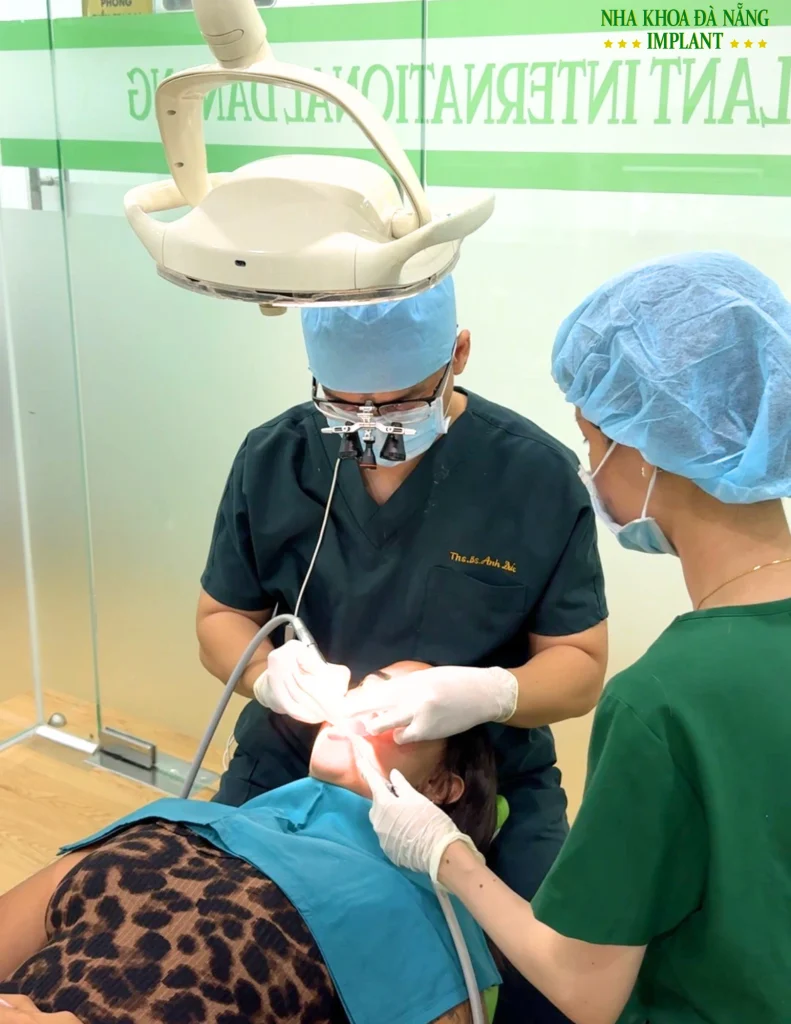
At Da Nang Implant Dental Clinic, each case of tooth loss is carefully examined and individually planned based on clinical findings and diagnostic imaging. Schedule a dental examination to receive professional advice on a safe and appropriate restoration option that supports long-term oral health.
The information in this article is for reference only and does not replace a direct diagnosis or treatment recommendation from a dentist

Ngày: 19/04/2025

Ngày: 26/10/2023
Ngày: 24/08/2026

Ngày: 22/08/2026

Ngày: 20/08/2026
Ngày: 14/08/2026